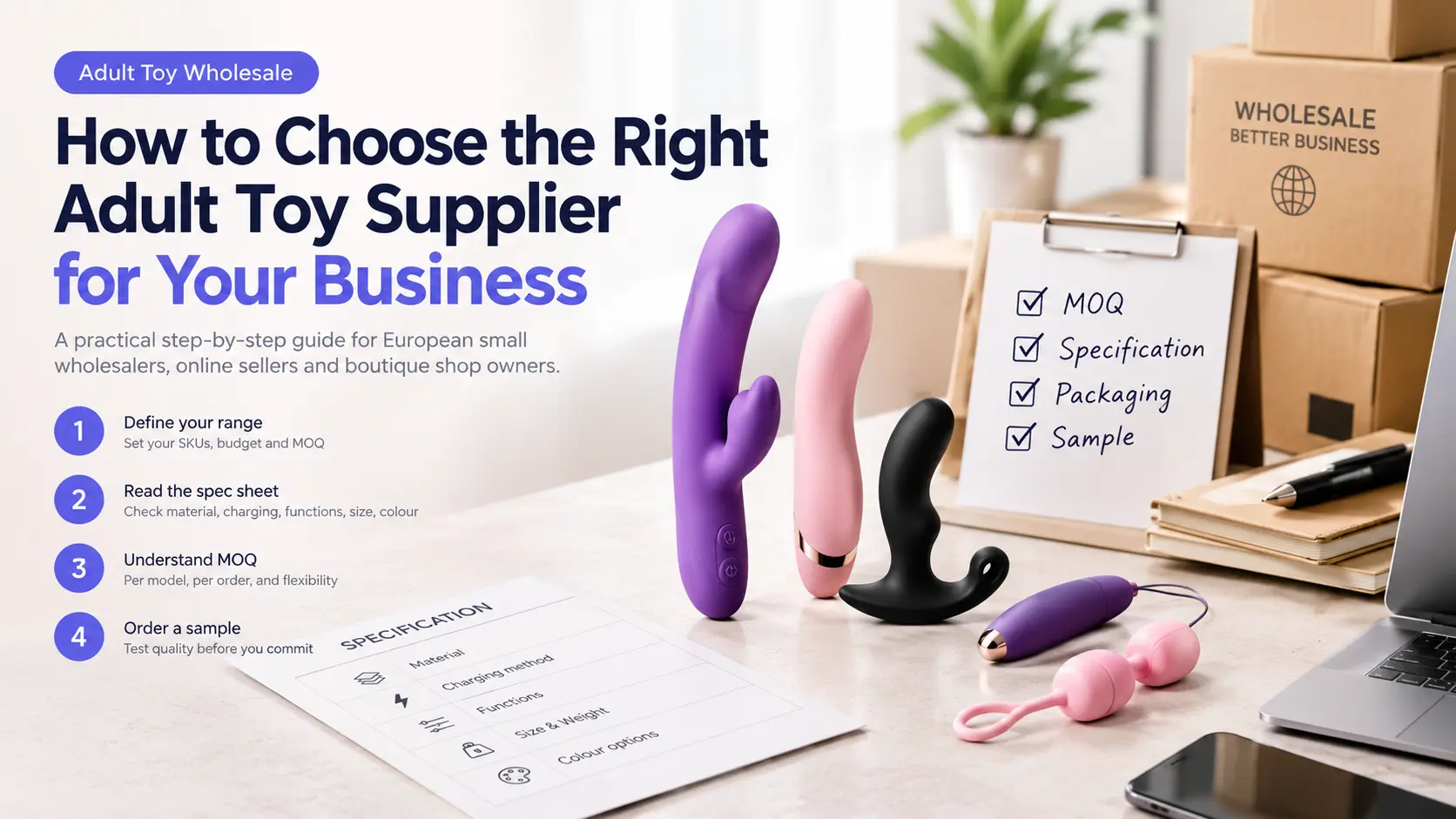

How to Choose an Adult Toy Wholesale Supplier: A Practical Guide for European Small Wholesalers
If you are buying adult products to resell in Europe, the supplier you pick decides what your first order actually costs you. This guide walks through the questions that matter before you send a single enquiry: what each model's minimum order quantity really is, how to read a spec sheet like a buyer instead of a shopper, how to ask for samples properly, why packaging should be settled before price, and what EXW does and does not cover. It is written for small wholesalers, online sellers and boutique shops who order shallow and wide, and who need a first order they can still react to.
Short answer first: before you request a quote from an adult toy wholesale supplier, check four things in this order. The minimum order quantity per model. What the specification sheet actually promises. How the packaging arrives. And whether you can buy a sample before committing to bulk. Your unit cost depends on all four, so pricing the product before you have those answers is guesswork.
This guide is for European small wholesalers, online sellers, boutique shop owners and small distributors. It assumes a specific profile: you do not audit factories, you judge a supplier from samples and a spec sheet, you are sensitive to unit cost, and your orders are fragmented across several models rather than concentrated in one. The checklist follows the order in which those decisions actually have to be made.
Step 1: Define your range before you contact anyone
Most first orders go wrong before the supplier is involved. A buyer assembles a list of interesting products, sends it out, then discovers that half of it is unavailable in the colours they wanted, or that the order is spread across fifteen models at quantities nobody will produce economically.
Work out three numbers first. How many SKUs you can realistically sell in the next two quarters. How much cash you are willing to hold in stock. And how many units per model your own demand supports. A small shop turning over two units a week per model does not need the depth a web store on paid traffic needs, and pretending otherwise ties up cash in slow lines.
A practical starting point is a shallow, wide range: fewer units per model, more models, so you learn which products move before committing deeper. That only works if the minimum order quantity is low enough per model to make breadth affordable, which is why MOQ is the first question, not a late-stage negotiation point.
Step 2: Read the specification sheet like a buyer, not a shopper
A consumer reads a product page to decide whether they want the thing. A wholesale buyer reads the same information to decide whether it can be sold, explained and reordered. Those are different questions, and the second one needs the spec sheet to answer five points.
Material, and where it sits on the product
“Silicone” on its own is not enough. You need to know which part is silicone and which part is not. A device described as silicone over ABS uses silicone on the body and a harder plastic shell underneath, usually for the handle, the control section or the structural frame. A device described as liquid silicone is a softer moulded body with a different feel and a different cost position. Both are legitimate, they are not interchangeable, and customers who own one of them notice the difference.
Charging method
Two charging systems dominate the wholesale range: USB charging, where a port is exposed on the body, and magnetic charging, where the contacts sit on the surface and the shell stays closed. Magnetic charging usually means fewer points of water and dust ingress. USB charging is common at lower price points. The practical question is different, though: whether the charging accessories are consistent across the models you intend to stock. A range where one charger fits several products means one accessory, one spare part and one support answer instead of three.
Function count and function type
“Ten modes” is a specification, not a benefit, and it is worth separating vibration from movement. Vibration is the baseline. Movement modes, meaning swing, flap, tap, slide and thrust, are a different selling proposition because the customer can see the difference in a product video. Inside one supplier’s range you will usually find a split: single-motor models at the entry point, dual and triple motor versions above them, and movement-based models at the top. Knowing that split lets you build a range ladder instead of picking products at random.
Size and weight
Weight is the fastest proxy for how substantial a product feels in the hand, and it is also the number most often copied incorrectly from a supplier listing. A 100 g wand and a 316 g wand of the same family read very differently to a customer and carry a different cost position. Keep weight on your comparison sheet, because it is the dimension where two seemingly identical products separate.
Colour availability, per model
Colours are usually listed per model, not per range. If you want a consistent shelf, check whether the colours you intend to carry exist across every model you selected. A range that looks unified in a catalogue often turns out to have four colours on one wand, two on another and one on a third. The spec sheet also will not tell you how the box looks or what the minimum is in an unlisted colour. Those are supplier questions.
Step 3: Understand how minimum order quantity actually works
MOQ is the number that decides whether a supplier is usable for a small business, and it is the most frequently misunderstood. Three things matter.
First, MOQ is normally set per model, not per order. A minimum of 200 pcs per SKU means that if you want ten models, you are looking at ten times the minimum, not one minimum spread across the range. This is the calculation that catches buyers out, and it is worth doing on a spreadsheet before you shortlist anything.
Second, MOQ and colour interact. Wholesale minimums usually apply to the model as a whole, but a custom colour or a custom box pushes you into a different tier. If a supplier quotes “1,000 pcs per colour” for OEM work, colours stop being a styling choice and become a stocking decision, because every additional colour is another 1,000 pieces.
Third, a low MOQ is not automatically good news. It is only good news if it is achievable across the models you actually want. A supplier advertising a low minimum on three slow-moving models is less useful than one holding a workable minimum across the whole range, including the models that sell.
Our wholesale minimum is 200 pcs per SKU across the range, set at a level where a small shop can buy into a category rather than gamble the month’s budget on it. That is a business position, not an industry standard: minimums vary widely, and any figure you are quoted is specific to that supplier and that model.
Step 4: Ask for samples the right way
A sample order is the cheapest risk reduction available to you, and most buyers use it badly. One email asking for “a sample” usually produces either a catalogue or a full retail unit at retail-adjacent terms. A request specific enough for the supplier to quote properly works far better.
State the models you want to inspect, by name or SKU, and the colour for each. Say whether you want the standard retail box or a plain one. Ask what the sample quantity limit is per model, and what the sample terms are, including whether the sample cost is credited against a later bulk order. Policies differ, and it is a fair question to raise before you pay.
Then use the sample for what it can tell you. It tells you how the product feels and how loud it is. It tells you whether the buttons are usable without the instructions, which matters more than buyers expect, because unclear controls generate support messages. It does not tell you how a production run of 200 will behave, or how the supplier handles a problem, which is why the next two steps matter as much as the sample.
Step 5: Check the packaging before you check the price
For a European small wholesaler, packaging is a merchandising decision, not a logistics detail. Neutral packaging means the product arrives without a supplier logo, a factory address or supplier contact details on the box or the product. That is deliberate: it lets the product go onto your shelf or your listing as your own line rather than as something a customer can trace back to a third party.
Ask three packaging questions before ordering. Is the standard box neutral? What exactly is printed on it, including any address block or contact line? And is a plain outer carton available?
Do not assume neutral means cheap. A neutral box is still a retail box with a product window and a printed specification panel. What it lacks is an identity, and that gap is where your own label, sticker or branded sleeve goes. Buyers who plan that step in advance get a finished-looking product; buyers who discover the gap at delivery end up relabelling boxes in a back room.
Step 6: Decide whether you need wholesale or OEM
Wholesale buys you the product as it exists: standard box, standard colours, minimum of 200 pcs per SKU, shipped on EXW terms from the point of departure. You are buying availability and speed, and you are not asking the supplier to change anything.
OEM buys you the product with your identity on it, and it starts at 1,000 pcs per colour. That jump is not arbitrary. Custom runs involve artwork, print setup, a colour-specific production slot and a box layout built for your order, so the minimum has to be high enough to cover the setup meaningfully. If your planned order is 300 pieces, OEM is not the right conversation yet, and a supplier who says otherwise is either upselling you or has not worked out the print economics.
If you are considering OEM later, the useful preparation now is to choose products from a range you already sell, because your first custom run is far easier on a model you have already moved at wholesale level. The custom process is outlined on our OEM and private label page, and it is worth reading before you brief artwork.
Step 7: Shape the range, do not just fill it
A supplier’s catalogue is not a plan. Buyers who order well tend to shape the range around three practical ideas.
Build from families rather than isolated products. A product family is a set of models sharing a motor platform, a charger and a box layout, offered at different sizes or power levels. Families merchandise more easily and cost less to support, because a customer question about one model answers for the others. A ring range where the same charger fits the single, dual and triple motor versions is the clearest example: three products, one spare accessory type.
Cover the category with one entry point and one step up. A buyer testing a category does not need five products in it, only the cheapest sensible way in and one clear upgrade. Our wholesale vibrator range runs this way, with a compact wand and a heavier version sharing the same motor specification, so two price points sit on one proven product rather than two unrelated bets.
Spread across categories only as far as your customer base supports. The five categories sold in volume to small European buyers are vibrators, suction toys, cock rings, egg vibrators and masturbators. Rings and eggs work well as add-on lines because they sit beside a main purchase at a low unit weight, and compact suction models fill the same role in gift and bundle listings. The mistake is opening all five categories at meaningful depth in one order, which spreads your cash across five unproven bets instead of proving one.
Step 8: Understand EXW before you compare anything
EXW means ex works: the supplier’s responsibility ends when the goods are made available at the named departure point, and the buyer arranges and pays for everything after that. For this business that point is Shenzhen or Dongguan. Comparing an EXW figure against a delivered figure is comparing two different things, so establish which one you are being quoted before you compare.
Under EXW, you or your forwarder handle export clearance, freight, insurance, import duty and customs at your end. If you have never shipped from China, talk to a freight forwarder before you place the order, so you know your landed cost per unit and which documents they will ask for. Ask the supplier for carton dimensions, carton weight, units per carton and total carton count, because your freight quote depends on those numbers. If you buy from more than one source, ask about consolidation as well: goods from several suppliers can often be combined at a single warehouse before export, which usually costs less than two separate shipments.
Common mistakes that cost first-time buyers money
Ordering too narrow and too deep. One model at 600 units concentrates your entire risk in a single product’s performance, and you cannot react if it does not sell.
Skipping the sample. The cost of a sample is small; the cost of 200 unsellable units is the whole order plus the freight.
Choosing on unit cost alone. Two products at a similar cost can differ on charging system, function type, weight and box quality. Cost is the last variable to compare, not the first.
Assuming OEM is available at any quantity. It is not. If a custom run is the plan, the 1,000 pcs per colour threshold has to be in the plan from the start.
Leaving packaging to the end. Neutral packaging is only an advantage if you have decided what replaces the missing branding, and that decision affects your timeline.
Questions buyers ask before a first order
What is the minimum order quantity?
200 pcs per SKU for standard wholesale across our range. Minimums are per model, so plan the total as the minimum multiplied by the number of models. Other suppliers set their own terms, so confirm each figure rather than assume it carries across the sector.
Can I mix models in one order?
Yes, subject to each model meeting its own minimum. That is what makes a shallow, wide first order practical: several models at the minimum each, rather than one model at a large quantity.
Is the packaging really neutral?
Yes. No logo, no factory address and no contact details on the box or the product. The standard box is still a retail box with a product window and a printed specification panel, so it displays normally on a shelf; it simply carries no third-party identity.
Can I put my own brand on it?
Yes, through OEM from 1,000 pcs per colour. Colours are counted separately, so two colours means two runs. Below that threshold the practical route is standard wholesale with your own labelling added at your end.
Can I get a sample first?
Yes. Send a specific request naming the model, the colour and the box type you want to inspect, and ask what the sample terms are. A precise request gets a usable answer in one round.
What does EXW cover, and do you hold stock in Europe?
EXW covers collection at the named departure point in Shenzhen or Dongguan; freight, insurance, duty and import handling at your end are yours to arrange. Goods ship from China rather than from European stock, which is why the forwarder conversation belongs at the start of your planning. Ask for carton dimensions, carton weight and units per carton so you can get a freight quote before you commit.
How long does production take?
It depends on the model, the colour and the order size, so treat any general figure with suspicion and ask for a lead time against your exact list. This is a question to settle before the order, not after it.
Do you show prices on the site?
No. Pricing is quoted per enquiry, because the figure depends on which models you want, at what quantity and in which colours. Ask for a quote on a defined list and you get a number that actually applies to your order.
What if I want to test the market before ordering 200 pieces?
Start with the lowest weight, lowest complexity model in the category you want to test, and set your sample order from there. Category entry points are usually the compact models for exactly this reason.
Next step
If you want to work through this checklist against actual products, the wholesale adult toys range lists every model with its specification, or you can look at a specific entry point such as the compact wand vibrator or the single motor app-controlled ring to see how a family is structured across price points inside one platform. When you have a model list, send it to us with quantities and colours and request a quote or a sample. A defined list gets a specific answer, and that is a faster conversation for both sides.
Get the full price list, free, within 24h.
Request Price List