
Private Label Sex Toys: How Minimum Order Quantities Actually Work
Private label sex toys pricing starts with one question most buyers get wrong: which minimum order quantity are you actually being quoted? There are four tiers, and they stack. This guide breaks down the wholesale, packaging, custom colour and OEM minimums, explains why the OEM number is counted per colour, and shows how to plan a first order that is shallow and wide instead of narrow and deep. It also covers the six moves that lower your commitment without asking the supplier to lower the MOQ.
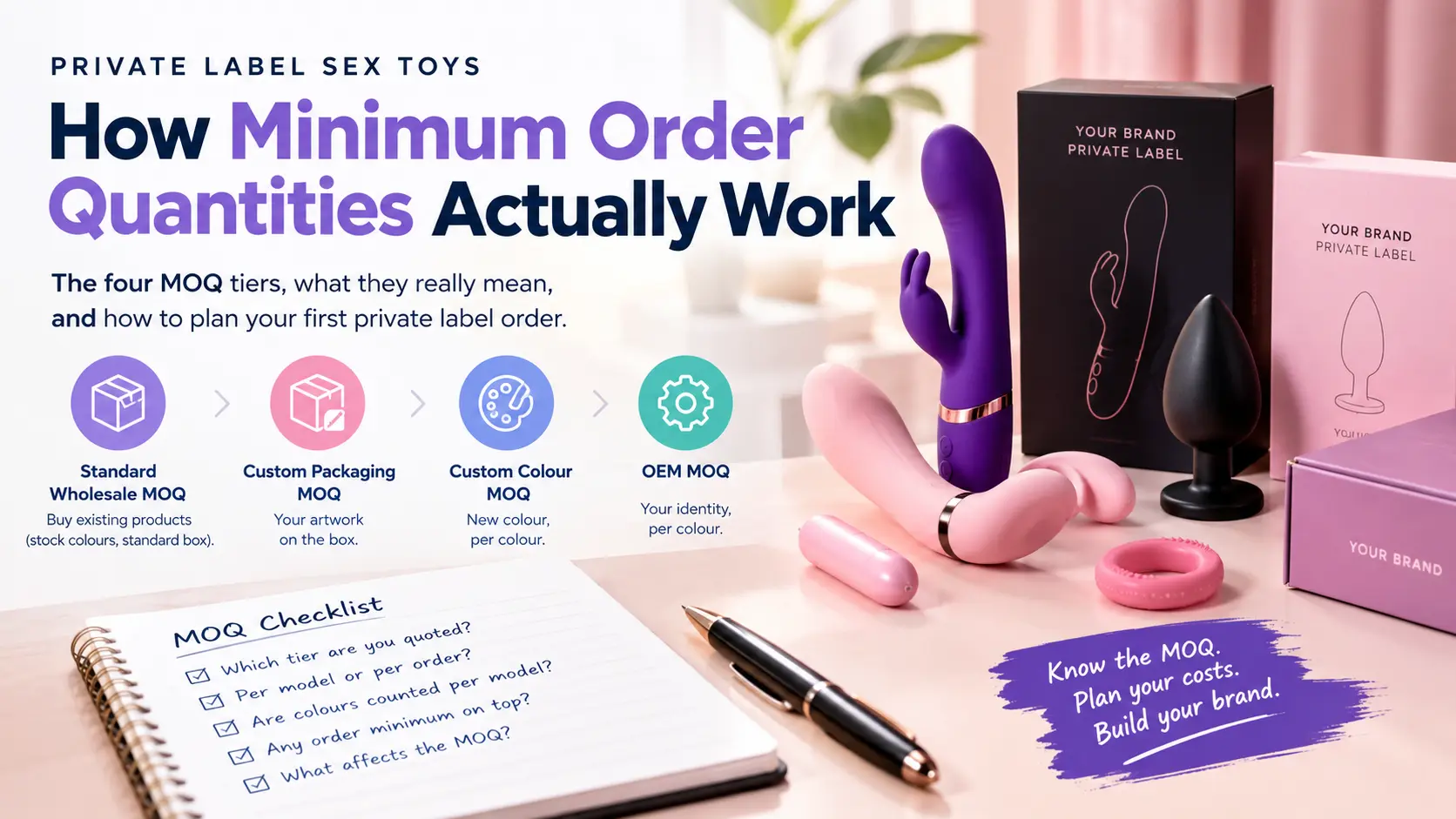
There is no single MOQ in adult toy sourcing. There are at least four, and they stack on top of each other: a wholesale MOQ per model, a custom packaging MOQ, a custom colour MOQ, and an OEM MOQ counted per colour. On our own range the standard wholesale MOQ is 200 pcs per SKU and the OEM MOQ is 1,000 pcs per colour, and those two numbers are the floor and the ceiling of the same ladder. Before you compare two suppliers, work out which of the four you are actually being quoted. A surprising number of “price disagreements” between buyers and suppliers are really scope disagreements about which MOQ tier the quote sits on.
This article is for European small wholesalers, online sellers and boutique shops who are moving from buying stock to putting their own name on a product. It assumes you are not going to visit a factory, that you judge a supplier from samples and specification sheets, and that your budget is real. The four tiers below are the same four that decide your unit cost, your cash exposure and how long your first custom run takes.
The four MOQ tiers, and why “what is your MOQ” is an ambiguous question
Most buyers ask one question and expect one number. Suppliers answer with one number and leave the other three unspoken, which is where the confusion starts.
Standard wholesale MOQ. The number of units of a single model you must take to buy the product as it already exists: stock colours, standard box, no changes to the product. This is the lowest tier and the one you should plan your first order around. On our range it is 200 pcs per SKU.
Custom packaging MOQ. The number you must take if the box carries your artwork. It is usually higher than the wholesale MOQ because the box stops being a stock item and becomes a printed job with its own setup.
Custom colour MOQ. The number you must take per colour if you want a colour the supplier does not already run. This is often quoted per colour rather than per model, which means two colours can double the order even when the model is unchanged.
OEM MOQ. The number you must take for a product produced with your identity rather than the supplier’s. On our range this is 1,000 pcs per colour, and it is counted per colour, not per model. If you want two colours on one model, that is two OEM minimums.
The practical consequence is simple. When a supplier says “our MOQ is 200”, they may mean the standard wholesale tier only. Ask which tier the number belongs to, and ask it in writing.
Why standard MOQ is set per model and not per order
This is the arithmetic that catches first-time buyers most often. An MOQ is normally a per-model minimum, not an order minimum. If the MOQ is 200 pcs per SKU and you want ten models, you are looking at ten separate minimums, not one minimum spread across a mixed pallet.
Some suppliers do run a single order minimum on top of the per-model minimum, and some allow you to mix models freely as long as each model clears its own figure. Both models exist, and the difference changes your planning completely. If you can mix freely, a first order of five models at 200 pcs each is 1,000 pcs and five products on the shelf. If you also have to clear an order minimum, the same five models may not be enough.
There is a second layer: MOQ is usually set per model, but colour availability is set per model too, and the two do not always line up. A catalogue can look uniform and still be four colours on one model, two on the next and one on the third. Before you commit to a colour story across a range, confirm the colour counts per model, because an MOQ that is fine on one line can become a problem when the line you wanted only exists in one colour.
What actually pushes an MOQ up
If you understand why a number is high, you can often find a version of what you want at a lower tier instead of arguing about the number.
Setup and tooling. Anything that requires a one-off setup before the first saleable unit exists tends to carry a minimum sized to cover that setup. Printing plates, box die cuts and colour-specific production runs are the usual examples. The minimum is not a negotiation tactic, it is the point at which the setup stops being a loss.
Raw material minimums. Colour is often a material decision before it is a product decision. If the body has to be moulded in a colour the supplier does not hold, the constraint may come from the material order, not from the assembly line. That is one reason a custom colour can carry a per-colour minimum that looks disconnected from the model itself.
Line changeover. Every change on a production line costs time. A run that is one colour, one box and one model is the cheapest thing a line can do. Each additional variable adds a changeover, and changeovers are what most minimums are really pricing.
Packing labour. Retail boxes are packed by hand far more often than buyers assume, especially for products with inserts and windows. A custom box with a new internal layout means new packing steps, which is why packaging MOQ and product MOQ are not the same number.
Colour counting. A “per colour” minimum is not a technicality. It means the supplier has to treat each colour as a separate run for planning purposes, and that is where budgets break.
How to read an MOQ quote before you compare anything
Two quotes can carry the same headline number and mean different things. These are the questions that separate them.
Is the MOQ per model or per order? If your supplier cannot answer this in one sentence, you are not ready to compare.
Is it per colour? A per-colour minimum on a product you want in three colours triples the commitment.
Does it include packaging? A 200 pcs standard MOQ and a 200 pcs “with your box” MOQ are different products, and the second one rarely exists at the same number.
Is any of it one-off? Artwork setup, plates and sampling are often charged once rather than per unit. Knowing which costs are one-off and which are per unit is the difference between comparing unit price and comparing total order cost.
Is the sample fee deductible? Many suppliers credit the sample cost against the bulk order. Ask, because it changes the true cost of sampling rather than the headline.
Is the number stable? A real MOQ is a policy, not a mood. If it changes between conversations, treat it as unconfirmed until it is in the quote.
Get the answers in writing, in the same document as the price. An MOQ confirmed in a chat thread is not an MOQ you can plan against.
Packaging: the tier buyers forget until the last week
For a European small wholesaler, packaging is a merchandising decision before it is a logistics one. Neutral packaging means the product arrives with no supplier logo, no factory address and no supplier contact details on the box or the product. It is deliberate rather than cheap: it lets the product sit on your shelf or your listing as your line, instead of becoming stock your customer can trace back to a third party.
Neutral is not the same as plain. A neutral retail box is still a retail box, with a product window and a printed specification panel. What it does not carry is identity, and that empty space is where your label, sticker or branded sleeve goes. Buyers who plan for that space early get a product that looks finished. Buyers who discover it in the warehouse end up labelling stock on the floor.
This matters for MOQ because there are two different moves available and they cost different amounts of commitment. If you take the standard box and add your own label, you stay at the standard wholesale MOQ. If you want the box printed with your artwork, you have moved up to the packaging tier and the minimum rises with it. Neither is wrong. What is wrong is planning for a custom box and budgeting for a standard one.
Three questions to ask before you order packaging: is the standard box fully neutral, what exactly is printed on it including any address or contact block, and is there a white or plain outer carton option. Those three answers decide whether you can sell the product as your own without opening a tooling project.
Planning a first order around MOQ
The mistake first-time buyers make is going narrow and deep: one model, a large quantity, all the risk on one product’s performance. It feels efficient because the unit cost is better. It is actually fragile, because if the product does not move you have no way to react.
A better shape for a first order is shallow and wide, and MOQ determines how wide shallow can be. If the standard MOQ is 200 pcs per SKU, then five models at 200 pcs each is a thousand units spread across five products you can learn from, rather than one product you are betting on.
Product families are what make that affordable. A family is a group of models that share a motor platform, a charger and a box layout, and differ by size or power step. Two examples from our own range show how this works.
The wand line runs a 100 g compact version and a 136.8 g larger version that share the same 20 mode motor and the same USB charging. Both are 200 pcs per SKU in four colours. To a buyer that is one product decision with two price points and one shared charging accessory, not two unrelated bets.
The app-controlled ring line is a three-step ladder inside one family: a single motor, a dual motor and a triple motor version, all USB rechargeable and all sharing one charger. Again, one accessory to stock, one spare part category, one customer service answer. A buyer who starts with the single motor and wants to upgrade later is extending a line they have already tested, which is a much easier conversation than starting a new one.
How MOQ moves your unit cost
MOQ and unit cost are connected, but not in the way most first-time buyers assume. The relationship is not “bigger order, better price” in a straight line. It is a step function, and the steps sit where the fixed costs land.
At the standard wholesale tier you are buying an existing product with no new setup, so the price is essentially the product cost plus packing. Moving to a custom colour adds a run that has to be planned on its own. Moving to a printed box adds artwork, plates and a packing change. Moving to OEM adds your identity to the product, and on our range that is the 1,000 pcs per colour tier.
The useful mental model is that you are not paying for quantity. You are paying to make a change, and the minimum quantity is the point at which that change becomes economically sensible for the supplier.
Six ways to lower your first order without asking for a lower MOQ
Most buyers open with “can you lower the MOQ”. It is usually the wrong request, because the minimum is tied to a real cost. These six moves lower your commitment without arguing with the number.
Start with stock colours. Stock colours sit at the standard tier. Custom colours sit above it. If your first run can live with the colours already on the line, you stay at the lower minimum and keep the custom colour for the second order.
Start with the standard box. Take the neutral retail box and add your label or sleeve. You stay at the wholesale MOQ and you learn what your packaging actually needs to say before you commit to print.
Mix models rather than deepening one. If per-model minimums are modest and model mixing is allowed, spreading the same budget across more models lowers your single-product risk without lowering quality.
Sample first, then scale the model that earned it. A sample order is the cheapest risk reduction available. The cost of sampling is small next to the cost of 200 units of a product your customers do not want.
Phase OEM instead of opening with it. Choose an OEM model from something you have already sold at wholesale. Your first custom run is far easier on a product you already understand, and the 1,000 pcs per colour commitment lands on something you have evidence for.
Use one family to cover two price points. A shared charger and shared box layout across a family means fewer accessories, fewer spare parts and a lower support cost, which matters as much as the unit price on a small first order.
What to confirm before you accept an MOQ
Before you agree to a number, confirm these in writing: whether the minimum is per model, per order or per colour; what packaging is included at that figure; which costs are one-off and which are per unit; the colour counts available per model; whether the sample cost is deductible; and what the lead time is for the specific combination you are ordering.
One more item is worth confirming even though it is easy to skip: what the product is and is not. We sell these as toys and novelty items, not as medical devices. If your market or your channel needs specific documentation, that is a conversation with your own compliance provider, and it is better to have it before you order than after your goods land.
Questions buyers ask before their first custom order
Is the MOQ per model or per order? Per model in our case. Our standard wholesale MOQ is 200 pcs per SKU, so a five model order means five minimums, not one shared minimum.
Can I mix models in one order? Yes, as long as each model clears its own MOQ. That is what makes a shallow and wide first order possible.
What is the difference between private label and OEM? Private label and OEM are often used loosely, and they are not the same. A custom logo is one capability, custom packaging is another, private label is a third, and OEM is a fourth. Each has to be confirmed separately. If a supplier offers a custom logo, that alone does not tell you they offer OEM.
Why is the OEM MOQ counted per colour? Because each colour is planned as its own run. Our OEM tier is 1,000 pcs per colour, so two colours on one model is two minimums.
What does neutral packaging actually include? A neutral retail box with a product window and a printed specification panel, with no supplier logo, no factory address and no supplier contact details. It is a retail box that carries no third party identity.
Can I get samples before committing to 200 pcs? Yes. Send the models, the colours and the box type you want to see, and ask about sample conditions in the same message. A specific request gets a usable answer.
Does a bigger order always mean a lower unit cost? No. Cost moves in steps, and the steps sit where the setup costs land. Bigger quantities inside the same tier do not necessarily move the unit price the way buyers expect.
Can you lower the MOQ if I pay more per unit? Not on our range. The minimums are tied to production and setup, not to a price trade. The practical alternative is to change tiers: stock colours and the standard box usually get you to the lowest commitment that still works.
Next step
If you want to run these four tiers against real products, the wholesale adult toy catalogue lists every model with its specifications, and the vibrator range shows how a family holds two price points on one motor platform. The suction toy, egg vibrator and masturbator ranges follow the same 200 pcs per SKU structure. The OEM and private label page explains the tier above standard wholesale. When you have a model list, send it with quantities, colours and the box you want, and ask for a quote or a sample. A specific list gets you a specific answer, and it tells you which MOQ tier you are actually standing on.
Get the full price list, free, within 24h.
Request Price List